
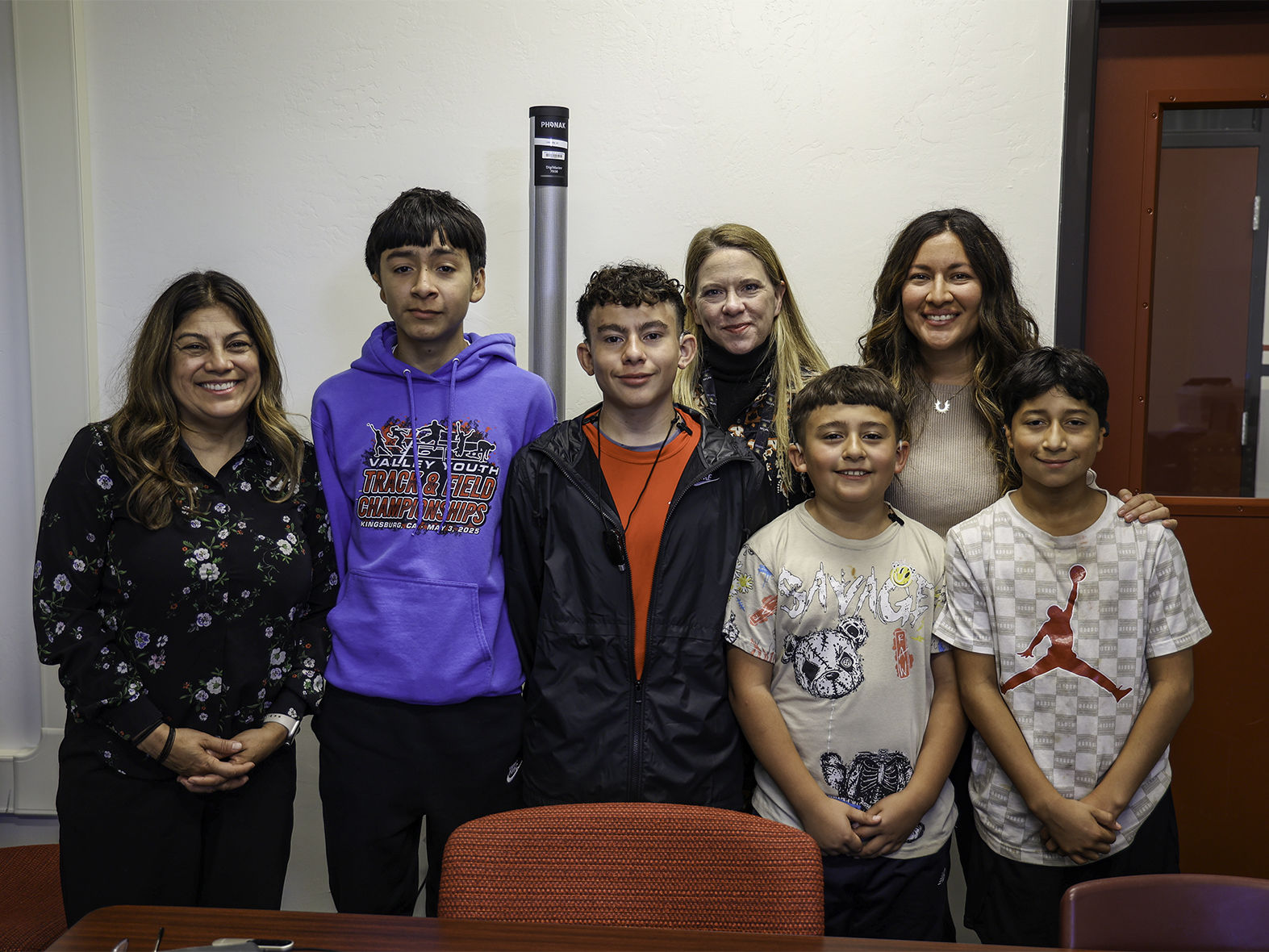
Four Lost Hills Students With Hearing Loss Lead by Example
Thursday December 4, 2025
At Lost Hills Union School District, four boys can often be found sprinting across the track, laughing with their teammates and friends, or swapping stories in the classroom. They are students, athletes, and leaders, and they also happen to experience hearing loss. But to their school community, that hearing loss is not what defines them.
“We are the lucky ones to have these boys on campus,” said Principal Veronica Sanchez-Gregory. “They’re amazing scholar-athletes.”
The group includes seventh graders Cristian Diaz and Alan Quiñonez, sixth grader Jonathan Verduzco, and third grader Dariel Diaz. Each uses different technology to hear: cochlear implants, hearing aids, or bone-anchored hearing aids (BAHAs). Each device is uniquely adapted to their type and degree of hearing loss.
“When I was little, I actually thought everyone had one of these,” said Cristian, gesturing to his cochlear implants. “I asked my dad, why is everyone not wearing this? Are they walking around deaf? I didn’t understand it because I was too little.”
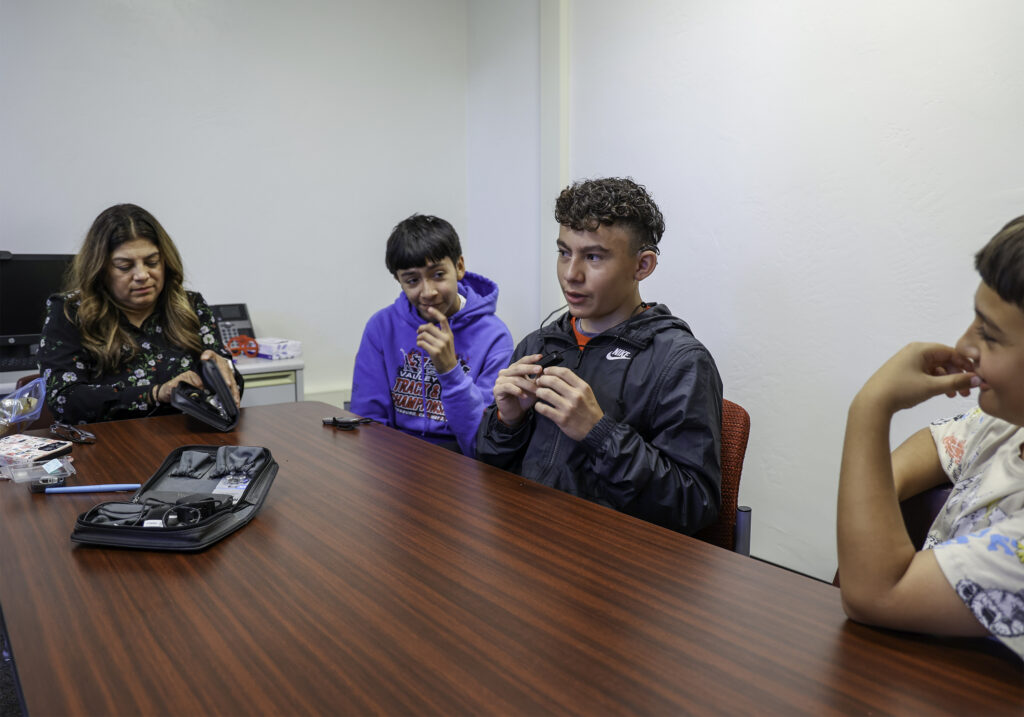
Cristian Diaz shows how to use a microphone to transmit sound through his cochlear implants.
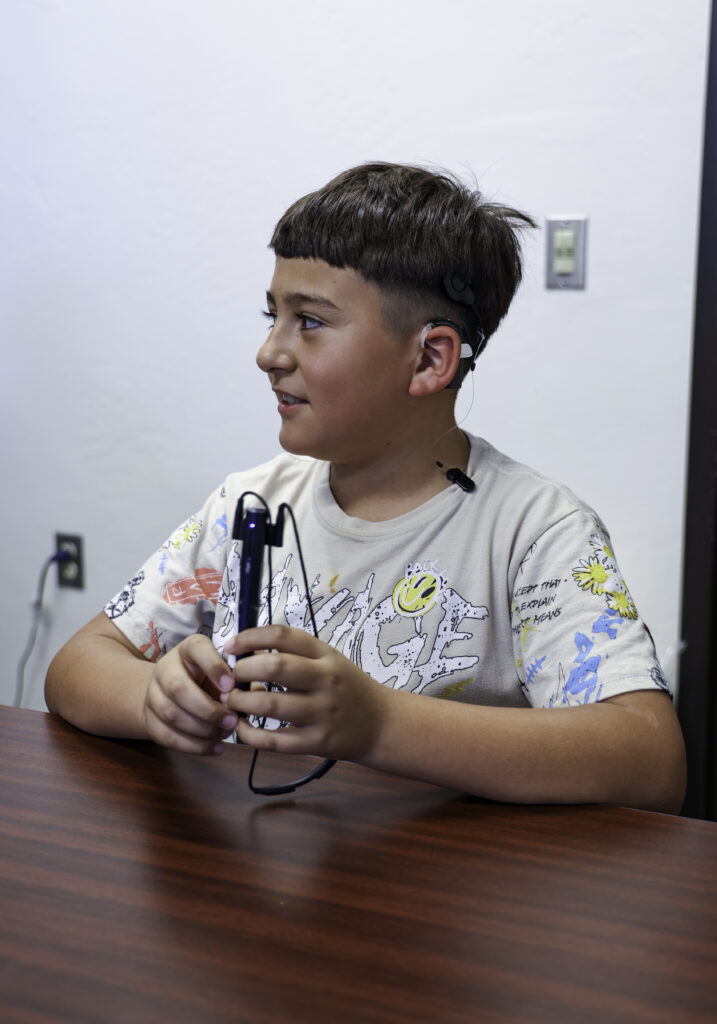
Brothers Cristian and Dariel use cochlear implants. Jonathan uses two BAHAs, while Alan’s Focus device is used only at school to support him receiving direct sound to his functional left ear to compensate for the absence of an ear canal in his right ear. All four rely on remote microphones worn by teachers, tabletop transmitters, or equipment that enables hearing in noisy classrooms and active school environments.
“All of their devices are amplifying speech, but they’re also amplifying noise. So by using these remote microphones/transmitters, it helps to pick up the intended voice,” Educational Audiologist Amy Robertson explained. “Usually, we have the teacher wear the remote microphone. It brings your voice through distance and noise,and can travel up to 65 feet so that they can take it with them to PE, and even have a friend wear the microphone to hear what is said in noisy small group settings.”
In addition to the personal equipment, the district purchased standalone speakers for the classrooms, which amplify the teacher’s voice even further, benefiting all students, not just those with hearing loss.
The boys’ support network includes their families, Lost Hills educators, and specialists from the Kern County Superintendent of Schools, including Robertson and Deaf and Hard-of-Hearing Itinerant Teacher Marisol Escudero, who have known some of the boys since early childhood.
“Administration and educators deserve a standing ovation for the immense pride, dedication, and honor they have for these students,” Escudero said. “This is top-tier education right here, where they’re making sure that these kids have access.”
Every year before school starts, Robertson and Escudero conduct in-depth staff trainings at Lost Hills. Teachers listen to video of simulated cochlear implants and try on the BAHA device to understand how hard it can be for students to separate voices from noise. They review audiograms, learn troubleshooting, and practice using remote mics. This training creates what Robertson calls buy-in from the staff. Hands-on learning as well as participating in an activity with earplugs and having the staff listen with a very slight to mild hearing loss gives the staff working with their deaf and hard of hearing students true empathy.
“The teachers here have a very good understanding of their hearing loss and the impact that their hearing loss has on their education,” Robertson said. “They want to stand up for you guys and do what’s right.”
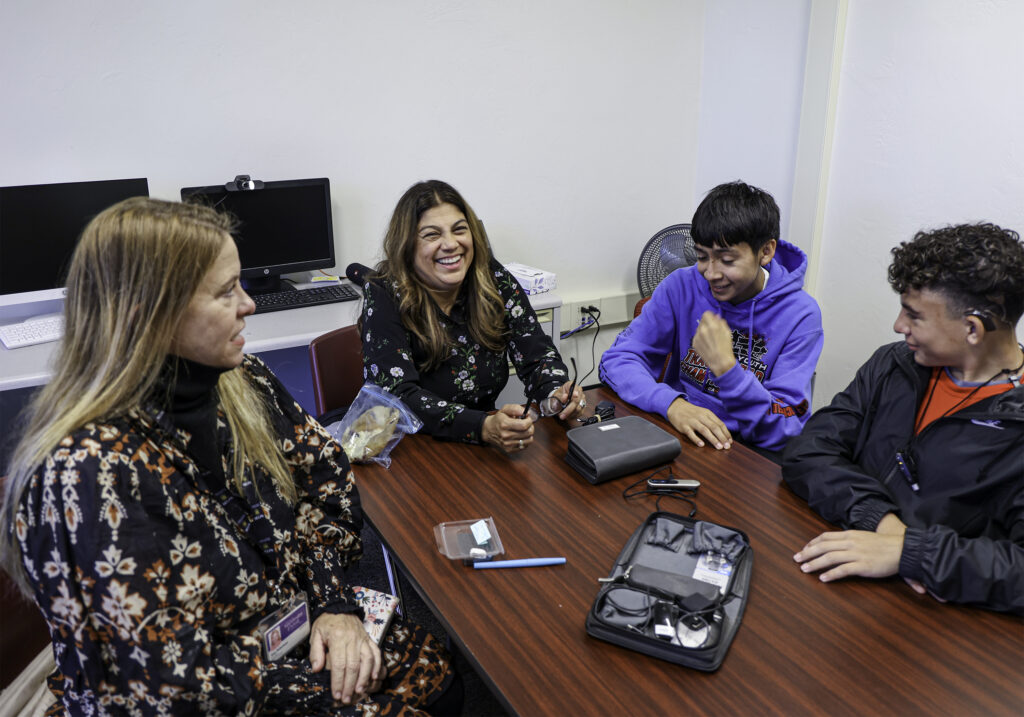
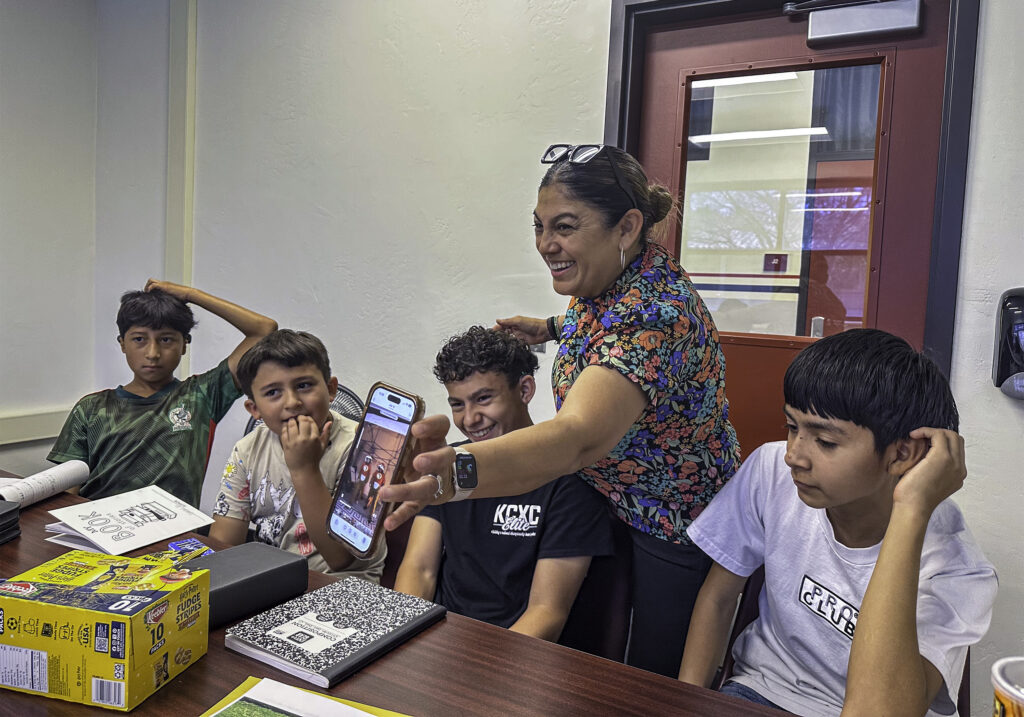
Students laugh and bond over shared struggles with hearing equipment (left) and internet memes (right).
The difference is dramatic. In many districts, audiologists struggle to get a teacher to wear a microphone or provide accommodations for learning strategies and equipment. At Lost Hills, teachers use the devices everywhere, including outside, because they know a working device is the difference between inclusion and isolation.
“Whatever they need, it’s our responsibility to ensure that they have it; whatever is going to make them more successful,” Sanchez-Gregory said. “For example, if Cristian runs out of batteries, it should be my responsibility to hold a battery pack for him.”
All four boys are runners, either on the track or the soccer field. They are fast and competitive, sometimes literally running so hard their hearing gear falls off. Once, when Jonathan lost his BAHA on a soccer field, his teammates, coaches, and staff fanned out to search until they found it. Dariel remembers his kindergarten classmates looking for his fallen device in the grass. Cristian once lost his device during the final stretch of a race, costing him valuable time while he searched for it.
“After, I would say, a solid 20 seconds, I finally found it, and then I tried to make it back all the way to the finish, sprinting the whole way,” he said.
The staff problem-solved immediately, purchasing a secure headband so it would never fall again. Sanchez-Gregory said the students deserve to run just like everyone else, and it’s up to them to troubleshoot problems and meet challenges as they come.
“I want them to be empowered so when they go to high school or in their own life, I want them to have those opportunities,” she said. “They’re just as important as everyone else.”
This December, Cristian and Alan will travel to Tennessee for a national cross-country competition. It’s the second time for Cristian, and the first for Alan.
“At first I thought cross country was easy, you just run,” Cristian said. “But it’s not. It’s hard. But I started to like the practices, the trips, the friends. It’s fun, and we do it together.”
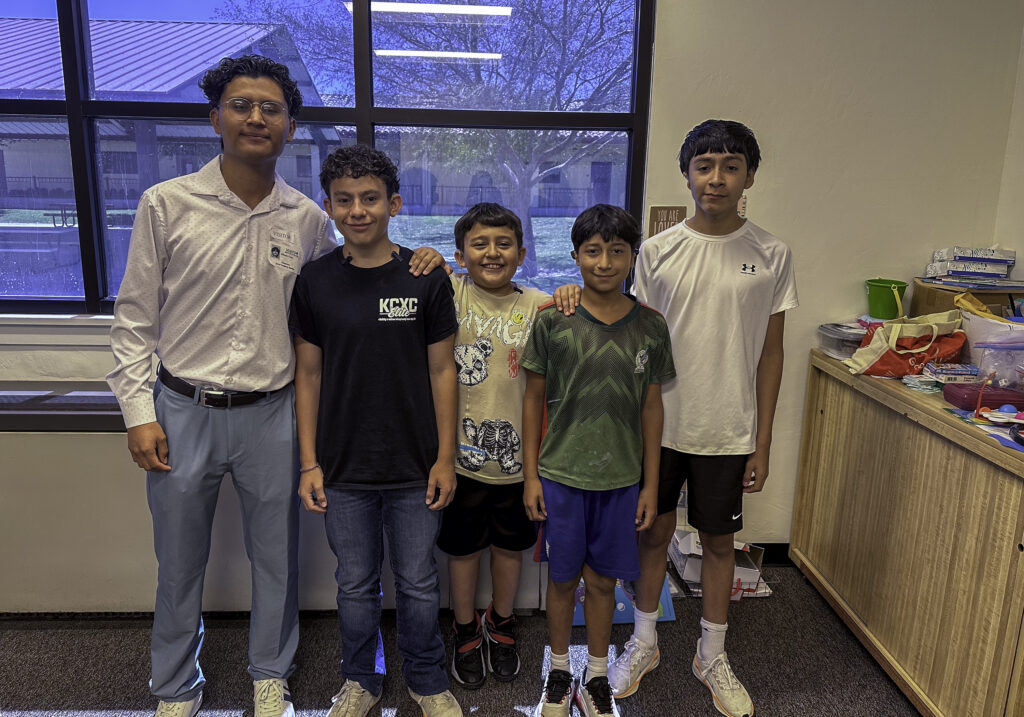
Boys pose with Alexis Cruz, who came to speak with them about overcoming challenges of hearing loss.
Recently, the boys met Alexis Cruz, a Wasco native who grew up with hearing loss, received cochlear implants as a child, and went on to run track, play music, excel academically, and now attends Princeton University. He returned home to Kern County and spoke with the Lost Hills students about resilience, technology, and empowering them to advocate for themselves, especially when communication feels hard.
“He’s like talking to your future self,” Cristian said. “He has a lot in common with us. He showed us why we should use our equipment in school, why it matters.”
Beyond the everyday maintenance of devices and batteries, Escudero said Lost Hills has gone above and beyond to build a community that supports and inspires confidence in these boys. Now, they are not shy about their hearing loss; they explain their devices to curious peers, spread awareness, and advocate for themselves.
“They feel so confident about their technology that they’re happy to share it instead of hiding it,” Escudero said. “I’m very proud of them for having that confidence, and I think this school has really fostered the idea that they are just like every other kid here.”
The boys say they’re grateful to have their equipment and access, but most importantly, they’re glad to know that they matter.
“I’m pretty happy,” Dariel said. “I’m happy they’re supporting me. I’m happy they help me listen properly. Thank you for the support.”
For the adults who do the work to ensure the boys feel equal and included, it’s not a burden but a privilege.
“Look what we get out of it. It’s so much love they bring,” said Sanchez-Gregory. “They are my kids. I’m so proud of them.”

By Katie Avery
Katie Avery joined the Kern County Superintendent of Schools in 2023 as a Communications Specialist. As a former journalist and marketing professional, her passions include media and storytelling. Before joining KCSOS, Avery worked for various local TV stations as well as the health care industry.